Showing posts with label Biologi. Show all posts

Friday, June 10, 2011

Freshwater stingray facts: Different chromosome number between males and females in two Potamotrygon species (P. aff. motoro and P. falkneri)

One of my main interests when it comes to fish are the freshwater stingrays of south america. A few years ago I had two adult P. motoro rays and a adult of a unidentified species, both from south america. The pair of motoro rays were one female and one male and they had baby stingrays a few times during their time in my posession. The baby i had for the longest was a female. On the outher appearance of stingrays and other Chondrichthyes it is very simple to distinguish between male and females, males have one clasper on each pelvic fin and females have nothing but their normal fins. However what cytological differences underlie the sexes of the freshwater stingrays of south america?


My two old adult P. motoro rays with the male in the background.

This question Vanessa Paes da Cruz and colleages answered in a paper published Neotropical Ichthyology march 31 this year. They collected 30 P. aff. motoro and 34 P. falkneri specimens from different rivers in Brazil.

They found that in both species females have a diploid number of 66 chromosomes while males have 65 chromosomes. This is interesting, males have an uneven number of chromosomes! When they looked further into what chromosomes that differed between males and females it appeared to be the sex chromosomes that differed. They found that the sex chromosome system in these two species consisted of this arrangement: X1X1X2X2/X1X2Y. Possible differences in number of chromosomes have previously been proposed in other Potamotrygon species and the reason for this difference they attribute to a ancestral system similar to the one seen in humans XX/XY where the Y once during evolution have fused to an autosomal chromosome. This then resulted in a new Y chromosome and the X2 chromosome. This later resulting in the "new" X1X1X2X2/X1X2Y system seen in these two species. 

One thing that came into my mind while reading this article was if this system also could be the result of a hybridization of two Potamotrygon species a long time ago. Many of the species of the Potamotrygon genus have to my knowledge been known to hybridize in aquarium. However the reason for this arrangement it is certainly interesting!

/Simma lungt!

Ref.
Vanessa Paes da Cruz, Cristiane Kioko Shimabukuro-Dias, Claudio Oliveira and Fausto Foresti, (2011), Karyotype description and evidence of multiple sex chromosome system X1X1X2X2/X1X2Y in Potamotrygon aff. motoro and P. falkneri (Chondrichthyes: Potamotrygonidae) in the upper Paraná River basin, Brazil., Neotropical Ichthyology, 9(1):201-208

Thursday, June 2, 2011

Animal of the week: Zebrafish (Danio rerio)


"-The zebrafish a model organism on the rise"

This is one of the most common introductions in scientific articles relating to zebrafish research for the last 20 years. But what is a zebrafish?

The zebrafish is a small, 2-4 cm, cyprinid fish from the genus Danio. It has its origin in the southeastern himalaya region in asia with its main distribution in India. It has five blue horizontal stripes running laterally on its body hence the name zebrafish.

Zebrafish are omnivorous and forms small shoals of 6-10 individuals. They do not take care of their offspring and they spawn in the middle of the water column during the early morning. The eggs fall down to the bottom and lay in the substrate for a few days until they hatch. The first few days after hatching the young zebrafish are attached to stones and other things on the bottom substrate using a few specialized cells on the head. The stick to the bottom until they have consumed the yolk sac. When its consumed they let go of the substrate and make their way to the surface to engulf a small amount of air to fill their swim bladder. When thats done they swim around up in the water column feeding on various small crustaceans and other small creatures until they are large enough to spawn, after apporx. 3 months. 

The short generation time of about 3-4 months is one of the reasons for its popularity in scientific research. This mean that it is quick and rather easy to create different strains and mutants for research. Another reason is that the zebrafish have had its genome sequenced, so molecular studies on zebrafish is easy.

Monday, May 2, 2011

Veckans djur Pirål (Myxine glutinosa)

Under min tid i en studentkorridor i Uppsala försökte jag köra veckans djur på en whiteboard jag hade i vardagsrummet. Jag tänkte här i denna blog bland annat återuppta denna tradition och tänkte börja med detta inlägg.

Vad kan det då vara för organism som är förärad denna första riktiga bloggpost en dag i början av maj 2011? Jag tänkte börja med ett djur som tillhör samma understam som oss människor, ryggradsdjuren, men som inte har några käkar dvs är ett käklöst ryggradsdjur. Djuret jag tänker på är arten av pirålar som förekommer i våra nordiska farvatten nämligen atlantisk pirål eller Myxine glutinosa som vår kära Karl von Linné döpte den till 1758. Denna art är, trots namnet, ingen ål utan tillhör klassen rundmunnar.

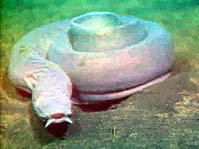
(Bild från wikipedia, stillahavspirål)

Pirålarna saknar, liksom alla rundmunnar utdöda och levande, käkar och klassificeras därför till Agnatha som just betyder käklösa. Deras kranium består av brosk och de saknar en ryggrad i den bemärkelsen att de inte har några kotor. Pirålars ryggrad består istället av en skyddad ryggsträng. Avsaknaden av en egentlig ryggrad gör att pirålarna kan slå en knut på sig själva utan problem. Deras kropp är täckt av slemkörtlar som gör att den kan utsöndra ett mycket glatt slem om den skulle råka på ett rovdjur. Pirålarna lever i huvudsak av as och saknar en ordentlig mag-tarmkanal. De saknar det man ofta förknippar med fiskar i dagliga livet såsom pariga fenor och fjäll. Pirålar saknar också det man kallar riktiga fenor och deras kropp är täckt av hud. De har två gälöppningar, en på vardera sida av kroppen och en näsborre mitt i "pannan". Deras ögon är endast för ljus/mörker detektering och är täkta av hud så de ser mycket dåligt,

Rundmunnarna, vilka också innefattar nejonögonen, är en grupp med djur som divergerade från de övriga ryggradsdjuren för mycket länge sedan och därför är de mycket intressanta i studier av ryggradsdjurens evolution. 

Simma lugnt tills nästa post,,,