Tuesday, December 6, 2011

Boldness and reproductive success in zebrafish

ResearchBlogging.org
Animals in general react in similar ways to stressful stimuli. There are two basic mechanisms in which animals react to stress. some animals react by being aggressive and actively try to attack the thing that is perceived stressful by the individual while other animals react by being passive and show low levels of aggression. The aggressive individuals have a so called proactive coping style while the inactive non-aggressive individuals have a reactive coping style. Proactive animals often are dominant and reactive animals subordinate in a social interaction. The coping style an animal will show can be determined by many factors for example genotype or environmental factors. The differences between proactive and reactive individuals is not only visible in the behavior but also in their neuroendocrinology. In vertebrates stress is regulated through the so called Hypothalamic-Pituitary-Adrenal Axis (HPA-Axis) or as it is called in fish the HPI axis (where I stands for interrenal, which have the same function as the Adrenals in mammals). The regulation of this axis differ between proactive and reactive individuals where proactive individuals show a lower activity of the axis than reactive individuals. 

The zebrafish, which is a commonly used experimental animal, is a fish that lives in shoals of approximately 10-20 individuals. Zebrafish has its native range in India, Myanmar and Bangladesh where it lives in small streams and flooded plains. Being a social fish species they interact between each other a lot. However how the boldness of an individual zebrafish contribute to the social hierarchy in the group had until recently not been investigated. At the day of my birthday this year my former supervisor published a paper with me among others as a co author (Dahlbom et al. 2011) where we investigated if one could predict social status by testing for boldness in individual zebrafish i.e. if boldness correlates with coping style.

To test this we first tested the boldness of individual zebrafish and then put the fish in a tournament where they met conspecifics in two rounds to isolate the extremes in dominant and subordinate individuals (see Dahlbom et al. 2011 for details). What we could see was that individuals that proved to be bold in the initial boldness screen actually more often ended up dominant (proactive) in a encounter with another zebrafish and thus boldness seem to correlate with coping style shown in the social encounter. 

Recently the first paper citing our paper (Ariyomo and Watt, 2011) was published. They further investigated the effects of boldness and aggressiveness in zebrafish but in the area of reproductive success of male zebrafish. Could it be that bold and proactive males had higher reproductive fitness than shy subordinate males? They saw that if a female was paired with a male it didn't make any difference between bold and shy males on the number of laid eggs by the female. However bold and aggressive males succeeded better with fertilizing eggs. Thus, more eggs in the tanks with a bold aggressive male were fertilized than in thanks with a shy non-aggressive male. 

So to conclude bold zebrafish seem to be more likely to become dominant and be proactive than shy zebrafish. Bold zebrafish males also have a higher reproductive success than shy males by being more successful in fertilizing eggs. Then you might ask, why isn't all zebrafish bold and proactive, why is there still reactive shy individuals? This could be explained by the fact that the different coping styles actually both have their benefits, however in different environments, and thus are both types maintained in the population. 

References
Dahlbom SJ, Lagman D, Lundstedt-Enkel K, Sundström LF, & Winberg S (2011). Boldness predicts social status in zebrafish (Danio rerio). PloS one, 6 (8) PMID: 21858168


Ariyomo, T., & Watt, P. (2011). The effect of variation in boldness and aggressiveness on the reproductive success of zebrafish Animal Behaviour DOI: 10.1016/j.anbehav.2011.10.004

Saturday, December 3, 2011

Animal of the week: The yeti crab

"...imagine theres no sun..."
This is probably something John Lennon would have written in the lyrics of imagine if he were a Yeti crab. Fortunately enough he wasn't a yeti crab, because if he was e would probably not have had the cognitive skills needed to write such master pieces. 

The Yeti crabs are (not very skilled in terrestrial music culture), as their name implies, white and hairy. They live in deep water with the first species discovered off the coast of Easter island in 2005 (Macpherson et al. 2005) and the second species the following year (Thurber et al. 2011). The two species have been assigned a genus, Kiwa. 

The interesting thing about these crabs is not that they are white and hairy, although thats pretty awesome in a way, but that they actually culture bacteria on their hairs and use these as their main food source. But the coolness about these critters does not even stop here! The bacteria they culture produces energy from the inorganic gases on the sea floor were these crabs roam about. This mean that the crabs actually live a Sun isolated life fueled purely by the gases of the deep sea floor!  


Some references: 
Macpherson, E., Jones, W. & Segonzac, M. Zoosystema 27, 709–723 (2005). 
Thurber, A. R., Jones, W. J. & Schnabel, K. PLoS ONE. 6, e26243 (2011).

Thursday, September 29, 2011

Fresh water stingray facts part III: Thinking rays.

Now you all might think that I shall rename the blog to stingray addict but this will be the last post about rays for a while :).

Rays and sharks in general is often perceived by aquarists as very smart creatures. Compared to many fishes sharks and rays have relatively large brains and in some studies, however very few, been shown to be rather smart. A large part of the brain of sharks and rays is dedicated to processing data from the Ampullae of Lorenzini which is the electro-sensory organ to locate prey. Freshwater stingrays of the family Potamotrygonidae generally have fewer of these ampullae which mean that their brains are not as large as in sea living stingrays. However their brains are still relatively large. The question is how smart are these rays really?

Tool use have been observed in many lineages of the animal kingdom, such as in primates (both human and non-human), in birds and in cephalopods to give some examples. However observations of this kind have been rare in the largest group of vertebrates, namely teleost fish, until now. In a few observations members of the wrasse  family (Labridae) have been seen using stones on the sea floor as anvils while trying to crush clams. This have been observed in three different genera of wrasses so it seem to be a common method used by these fish. The first observation of tool use in wrasses was described in 1995 for the yellow head wrasse.


ResearchBlogging.org
So tool use have been observed in several species throughout the animal kingdom, and particularly in the bony fish lineage including tetrapods. The cartilaginous fish lineage on the other hand is less studied when it comes to tool use and memory studies. In 2005 a research group used five captive breed Potamotrygon castexi stingrays of the same litter to study cognitive abilities of these rays. They used a plastic tube with one white and one black painted side. On one side of the tube there was a mesh on the inside and the other side was open. Inside the tube they placed a piece of irresistible food for a stingray. The food was, due to the mesh, not accessible from one of the sides of the tube. What they observed was that the rays learned quite well that if they did the right thing they would get the food, they also learned the color on the side of the tube that was associated with the possibility to access food. The way the rays accessed the food was through blowing a jet of water into the tube to sort of flush the food out. This method, by blowing a jet of water, is used by many ray species to uncover pray hidden in the sediment. 

The authors of this paper suggest that this is an observation of tool use in a cartilaginous fish species, using water as a tool to access the food. However if this really is tool use is a matter of definition since its a behavior the rays are born with knowing what to do. One can however argue that in the setting with the test pipe it is in a way tool use since they need to learn to get the food out using the water. I would rather state that the paper is a good study on learning and memory in stingrays rather than an observation on tool use. In any case freshwater stingrays are very interesting and more studies on their cognition would be interesting.


Kuba MJ, Byrne RA, & Burghardt GM (2010). A new method for studying problem solving and tool use in stingrays (Potamotrygon castexi). Animal cognition, 13 (3), 507-13 PMID: 20020169

Thursday, August 11, 2011

What is a fish anyway?


One discussion that frequently appear around the lunch table at work is wether humans and other tetrapods are fish. New Oxford American Dictionary define the word fish like this:

"...a limbless cold-blooded vertebrate animal with gills and fins and living wholly in water..." 
Clearly humans and other tetrapods in the majority of the cases lack these attributes. However in many cases the boundaries are not as clear. For a couple of examples we have the lobe finned fish, that possess very limb like fins with even many of the bones of tetrapod limbs; we have the axolotl, a neotenic salamander, that carry gills all there life; we have the mudskippers, that live a substantial time of their life on land and as a final example we have many of the large pelagic shark and game fishes that in a sense are warm-blooded (endotherm). This highlights the difficulties in defining whats a fish and that the definition of a fish, which includes sharks, rays and chimeras as well, may be a old and outdated way of defining this diverse group of animals.

So in some cases the morphological attributes cause confusion, but what groups of animals are included under the definition of the word fish then. Considered, as fish, are cartilaginous fish, ray-finned fish, lobe-finned fish (excluding tetrapods) and the lampreys. However in a biological and evolutionary perspective (figure 1) tetrapods are descendants of lobe-finned fish (the reason for our resemblance within the bone set up of the limbs). So in a biological perspective it is silly to exclude tetrapods from the group of fish, a lungfish is in fact more closely related to you than to a common perch (Tip: http://timetree.org/). And to go further we are, together with the lobe-finned fish, more closely related to the common perch (a ray finned fish) than what cartilaginous fish are to the perch. Still the sharks are considered fish while we aren’t.

In a matter of fact fish in a biological sense fish as a group would include basically all vertebrate species.

Figure 1. Rough tree over the vertebrates. Groups of vertebrates qualifying as fish are marked by the pale red field. Tetrapods are excluded. 


Monday, July 25, 2011

River monsters and a really old citation...

Airing on Animal planet is a show featuring Jeremy Wade called River Monsters. Jeremy Wade is an angler and biologist traveling all around the world fishing for what they call river monsters. A common denominator for these fish is that they are often large and look weird. Some of them are venomous and have caused rare deaths. Often the species he targets isn't very new to science and often common in the aquarium trade. However the show never seem to acknowledge the knowledge present on these species in the scientific literature or in the aquarium hobby. They present each species as if it was new and almost unknown, probably due to dramaturgic effects...

In the episode 'Silent Assassin' (S03E05) we follow Jeremy to the Parana river in Argentina where he follow up stories and victim accounts of stingray "attacks" in the river. According to the locals theres a mysterious stingray living in the river attacking and killing locals and their animals. Instead of doing research in the field of stingrays he sets out on a mission to catch this 'river monster'. Most of the people a bit interested in Elasmobranchs would be aware of the family of stingrays inhabiting the river systems of South America, Potamotrygonidae. However the episode overlook this fact and attribute the attacks to a mysterious ray. This mysterious ray however is a rather well known member of the Potamotrygon genus, actually one of the bigger species if not even the biggest. The species of freshwater stingray in this case is Potamotrygon brachyura. This species was described by Albert Günther (back then named Trygon brachyurus) in the article "A contribution to the knowledge of the fish fauna of the Rio de la Plata" in 1880 so it is not totally new to science. In the episode they wrongly assign this species into the family Dasyatidae and shows a picture of a general whiptail stingray which is the common name of the family. However the Potamotrygon genus is one of four genuses in the family Potamotrygonidae or river stingrays. They are thought this mistake not completely wrong due to the closest extant sea living relatives of river stingrays are thought to be stingrays of the genus Himantura in the Dasyatidae family. 

River stingrays are generally docile and generally only sting victims in self defense. Thats what their poisonous spine are for, self defense, and nothing else. So I think its a overstatement to talk about attacks when often the rays are being stepped on.


Reference
Albert C L G Günther (1880). A contribution to the knowledge of the fish fauna of the Rio de la Plata Annals and Magazine of Natural History, 6, 7-13

Tuesday, July 5, 2011

And the lungfish said: "oh man, not again..."

The other day a college of mine at the blog Ego sum Daniel made a nice picture and wrote  a post on his blog about the totally awesome fish Coelocanth (Latimeria chalumnae). He also showes a estimated timetree of the divergence times between the different bony fish lineages based on an nice site and book called TimeTree. If one excludes the ray finned fish (Actinopterygii) and only look at the so called lobe finned fish (Sarcopterygii) we see the Coelocanths, tetrapods and lungfishes. If one excludes the 21000 tetrapod species the Sarcopterygii clade in the tree of life have only eight extant species. The Coelocanth genus (Latimeria) includes two of these species. Lungfishes (Dipnoi) are divided into two orders, Ceratodontiformes and Lepidosireniformes, that are further subdivided into three genuses. Ceratodontiformes with one extant genus Neoceratodus includes one extant species the australian lungfish. Lepidosireniformes on the other hand includes two genuses Lepidosirenidae and Protopteridae, south american lungfish and african lungfishes respectively. While the south american lungfish is the single species in its genus the african lungfishes consists of four species with a few subspecies. 

Clearly the tetrapod lineage of this clade made great success after populating land, but what have happened to the lungfishes since then, what is the evolutionary history of todays six species? Several fossils have been found and it seems that the lungfishes once was a quite large group of fish. Todays lungfishes are a monophyletic group where the Ceradontiformes lineage separated from Lepidosireniformes around 277 million years ago (figure 1). 


Figure 1. Rough phylogenetic tree over the divergence times between the three extant genuses of lungfish.

The South American and the African lungfishes diverged somewhere around 120 million years ago. Since a major force in speciation is separation of two populations by a barrier one suddenly realize that theres actually a barrier between the South American and African lungfish populations, the little puddle the Atlantic ocean! Geological studies have suggested that the Gondwana continent split between whats now South America and Africa about 120 million years ago. Isn't it beautiful? Molecular and geological data seem together to explain in part when they formed and why we today have the South American and African populations of lungfishes. 

ResearchBlogging.org
When the separation had occurred the African population diverged further finally resulting into what we see today with four extant species. Tokita et al. set out to sort out the evolutionary history of the African lungfishes which in previous studies had been suggested to be paraphyletic. What they did was to look at a part of the mitochondrial 16S rRNA gene and to use that to calculate the divergence of these four species by molecular clock. Their phylogeny of the four species roughly look like what i have drawn in figure 2. 


Figure 2. Rough phylogeny of the four extant African lungfish species with the respective divergence times.  

In their calculations they conclude that the P. dolloi and P. amphibicus diverged from the P. annectens and P. aethiopicus lineages between 76 and 53 million years ago. The P. annectens and P. aethiopicus species diverged from each other between 42 and 26 million years ago. These two species shares a lot of morphological characters and can sometimes be hard to distinguish therefore they have previously been proposed to be closely related to each other. These two species inhabits different types of habitats. P. aethiopicus is found in the large lakes and the nile river of eastern parts of Africa while P. annectens inhabits river systems of western Africa. The authors of the paper suggest that these two species diverged during the tertriary period. During this period, they say, there was substantial landrifting in central and eastern Africa accompanied by volcanic activity. This lead to a separation  of two populations which later resulted in the two species we see today. So once again, it seem, a major geological event have helped the lungfish to diverge further...

Tokita M, Okamoto T, & Hikida T (2005). Evolutionary history of African lungfish: a hypothesis from molecular phylogeny. Molecular phylogenetics and evolution, 35 (1), 281-6 PMID: 15737597

Tuesday, June 28, 2011

Two or one species? - A 134 year old snakehead story

For some reason I find it interesting when studies aim to sort out difficult problems such as distinguishing different species or resolving the evolutionary history of species, in particular vertebrate species. Therefore I happened to stumble across this study published 24 of June this year PLoS One. They looked at two species of fish within a family called snakeheads Channidae. These fish have a long slender body for fast stealthy attacks sort of like the eurasian and north american Pike (genus Esox) species. One could assume that these fish occupy the same types of niches in the subtropical to tropical waters of africa and south eastern asia. The family consist of two extant genuses Channa (Asia) and Parachanna (Africa). Several of the species of the Channa genus are very difficult to distinguish from each other and theres probably some undescribed species swimming around the rivers of south east asia. 

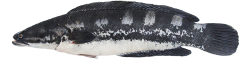
In the Thailand, Malaysia, Laos, Cambodia and Vietnam region on the mainland and parts of Sumatra, Borneo and Java theres a species named Channa micropeltes (giant snakehead). The giant snakehead is a large fish, hence its name, reaching a maximum size of about one meter. When young they have a nice red stripe along their lateral sides of the body giving them a pleasing look sadly attracting buyers in petshops around the globe not knowing their adult size. In southern india one find a quite similar species, differing at a few morphological points, called Channa diplogramma (Malabar snakehead). The overall look of the juveniles and the adults bears striking similarities to the giant snakehead which have spawned a debate on wether or not they indeed are two separate species or not. The author of the C. diplogramma species,  Francis Day, did actually 13 years after its description in 1878 synonymise it with C. micropeltes possibly due to these similarities. Now 134 years later Benzinger et al. set out to sort this mystery out.


Channa diplogramma picture from wikipedia
ResearchBlogging.org
In this paper Benzinger and colleges uses morphological and molecular data from specimens of these two species to try to sort out the time of divergence and if these are two species or one. They used data from mitochondrial 16S rRNA and cytochrome oxidase I (COI), the same gene they used in the paper on stingray evolution i reported on previously. What they found using the molecular and morphological data was that the two species are indeed closely related to each other. The divergence time between the two species is somewhere between 9.5 to 22 million years ago depending on which calibration point they use in their calculations. They finally conclude that the most possible reason for the divergence is a separation of the two populations that later lead to the two separate species.

I think this article sort of highlights how modern methods can resolve old problems, and now 134 years later Francis Day's snakehead species from India finally can be unsynonymised (if thats even a word).


Benziger, A., Philip, S., Raghavan, R., Anvar Ali, P., Sukumaran, M., Tharian, J., Dahanukar, N., Baby, F., Peter, R., Devi, K., Radhakrishnan, K., Haniffa, M., Britz, R., & Antunes, A. (2011). Unraveling a 146 Years Old Taxonomic Puzzle: Validation of Malabar Snakehead, Species-Status and Its Relevance for Channid Systematics and Evolution PLoS ONE, 6 (6) DOI: 10.1371/journal.pone.0021272